Sunday, 7 January 2024

The Blue Umbrella by Ruskin Bond - book recommendation of an Indian children's classic

One ritual I can take pride in now is reading aloud children's books to my son since he was a toddler. I have stopped this habit now that he is over nine years of age, but the habit has instilled in him reading as a permanent hobby. Reading aloud was not the only way to guide him to the world of books. During the coronavirus pandemic, we started listening to audiobooks made available for free by Audible at that time. And then, to wean off the habit of reading aloud by the parent, I also used the method of reading each page aloud alternatively between me and my kid. The last piece of information is not relevant to the purpose of this article: a book recommendation. I mentioned it to complete the experience that led him to develop a taste for reading without the need for us to nudge him.


I picked The Blue Umbrella during our phase of listening to stories on Audible. A heart-warming story that situates children amidst elders with flaws like dishonesty and greed, while transporting you to the hills, to the meadows and forests on hills, and to the lives of the tenacious people who live on hills. We had loved the story then. It had evoked such beautiful emotions in me that I had written a few lines in praise of the story:

Of times when a little girl
could wander alone in a valley.
Dark forests and lonely hilltops
“held no terror”.

Of lives in which children wandered barefoot,
ate wild berries to satiate hunger.

Of a village where no one kept birthdays.
Where the social fibre enabled adults
to accept and amend mistakes
at their own pace.

When our apartment building got a library, this was one of the books that I bought for the place. Recently, I came across another edition, this time an illustrated one. Now that my child was able to read on his own, I bought the illustrated one for him. He had loved Bond's book, Angry River but I was in for a surprise because he found this one "boring". Was my first impression wrong then? Due to its tiny size, I put my current reading-list aside and started reading. No, I was not wrong. If anything, I was more impressed with Bond's writing this time. The first time, it was about the world of Binya, the girl who chances upon The Blue Umbrella. This time, it was the literature. Who would believe that a text of about fifty pages can create an everlasting impact? Suffice it to say, I got back into my habit of keeping notes!! :) Bringing forth a few quotes and pictures from this edition published by Red Turtle, Rupa.


Quote 1:
"The umbrella was like a flower, a great blue flower that had sprung up on the dry brown hillside."


Pic 1: Binya finds a blue umbrella with the townsfolk who are on a picnic (copyright: Red Turtle)


Quote 2:
"Binya felt no fear when climbing trees. She was proud of the fact that she could climb them as well as Bijju."

Pic 2: Carried by the wind, the umbrella has fallen off a cliff but Binya wants it (copyright: Red Turtle)

Quote 3:
"She walked home through the darkening glade, singing of the stars, and the trees stood still and listening to her, and the mountains were glad."


With over a hundred titles to the author's credit, I'm sure my budding reader will find another work or another time to revert and appreciate this book. To reiterate my discovery, in the language of Gen-Z, this piece of literature is a masterclass in writing. From world-building to story-telling to humour to a vault of verbs, there is something for each of us to take away.

Did you know that Angry River and The Blue Umbrella are Ruskin Bond's first and second books, respectively, in the genre of children's fiction?

Friday, 8 December 2023

Malgudi Landscapes and Malgudi Adventures - the R. K. Narayan collections


While reading the above-mentioned books over the last few months, I got a chance to have a meaningful discussion with a book-lover friend. When you are reading a series of short stories or excerpts and some non-fiction in a book of 400 pages, it is easy to lose interest often. When one story is over, you say goodbye to those characters and quickly move on to the next ones. And the characters themselves are so different,  some are just interesting whereas some could be overwhelming. I hope this explanation serves as a caveat or my justification of what follows. Well, I tried. This year, I am also reading O Henry's short stories and the pace is jagged for the same reasons but more of O Henry later.

1. Malgudi Landscapes, edited by S Krishnan

A delightful mix of excerpts from novels, short stories, essays and travel diaries. 

🏘  The short stories made a lasting impact. The topics and genres are diverse. 'A horse and two goats', a casual encounter between an American and a broke, native man who does not know English set during colonial India reveals Narayan's knack for comic timing. This was way better on paper when compared with the adaptation. 'Uncle' is a poignant story of a man's childhood memory of one incident when he visits a photo shop and is made to wait alone for the framing of a photo as a young boy. Although the memory is the bulk of the short story, the closing comments by the narrator make one introspect how that event may have led to some of his decisions later in life. This one will remain with me for a long time. 'Selvi', a star singer with  humble beginnings, 'Annamalai', the gardener, Sam aka 'Lucifer', the nurse were such compelling personalities that Narayan eternalised them on paper.

🏘  In his novels, we meet the common people - people with professions - and experience their daily rigmaroles, where the stories are set mostly during the near decades of Indian Independence. Sometimes, there is some insight on colonialism in the southern part of India through short episodes of civil disobedience, or the education system in missionary schools and their influence on Indian societies. 'The English Teacher', supposedly the most autobiographical of all his novels, piqued my interest. The excerpt in this book reveals the relationship between the teacher and his wife as a young couple through a routine incident. 'The World of Nagaraj', an accountant who is also writing a thesis on Narada and faces a temporary predicament in his family, also made me want to read more of it.
My major challenge was that the common thread of Malgudi, the same streets, and locales, the railway station, the same Mempi forest, and the hills and recurring minor characters made it hard to remember some of the titles. I had to make mental notes to differentiate the Bachelor of Arts and The English Teacher which are both autobiographical in parts. I might mix up the stories of Nataraj and Nagaraj as one of these is a titular character. I skipped a couple of stories to avoid more confusion, and the Guide and Waiting for the Mahatma as these are in my to-read list.


🏘Essays could be the true indication of his wisdom which deepened, perceptibly, as he aged. Sharing a far-sighted remark below from The Reluctant Guru, 1974:
"...if you question him, you will find that our man has not given any serious thought to yoga and such subjects. Perhaps at a later date he may take to it when his more materialistic problems are over and when he begins to note that it's quite the fashion in your part of the world. At the moment the trend appears that he is coming in your direction, and you are going in his. So, logically speaking, in course of time, you may have to come to India for technology and the Indian will have to come to your country for spiritual research."
Apparently, Americans and some Indians in America thought him to be a mystic and astrologer based on his book, Guide. This brings me to his experience during the making of the movie. To make it spectacular, they changed the originally chosen locations from places near Mysore to Rajasthan and Delhi, they even changed the story and one of the main characters. The Hollywood director even went on to add a non-existent fight scene between a real tiger and a leapord for symbolism! He wanted one of the predators to die in real!! The list of celebrities associated with the movie is so full of disbelief that I recommend reading this book just for this particular piece, Misguided Guide.

🏘  The travel diaries reveal some more of his intimate personality. Whereas the episode in California, Berkeley about missing a train while at an empty train station is funny and unfolds the venturesome and nonchalant side of his personality, his spiritual travel to Sringeri feels like a serene experience and at the same time informational.

🏘 The parts from his mythological works are where he seems to take a neutral approach. The glory of the city of Mithila when Rama sets foot for the first time was new to me (Ramayana). The story on Bheema and Bakasura (Mahabharatha) certainly stirred my memory of hearing it from my mother, the details of which I had forgotten. The editor S Krishnan did a good job in selecting these stories. With mythology, I felt that Narayan may have sincerely translated the works rather than retelling them in his style. The job of a translator is hard - to adopt another's creative content and recreate it in other words without losing the essence.


2. Malgudi Adventures.

These are excerpts from his novels targeted at children. I felt that it is a confusing mix where the range of reader's ages is broader.

Would children even in higher-primary  or middle-school understand the nuances in 'The Framing Shop' (originally titled Uncle) which I have mentioned above or 'The Navaratri Adventure', which has children decorating the traditional doll stand but actually about the travails of their mother, a mistreated housewife?

One story that stands out is 'A Tiger in the School'. It is hilarious and apt for even younger children above five. This was so imaginative and yet realistic that it made me want to read the full novel. 'Leela and the Headmaster' was a surprise. Reformed schools, with informal setups, seemed to have started decades ago!! This excerpt is another reason to arouse my interest in The English Teacher.

A few other excerpts may not serve any other purpose than to reflect the state of the society in those times among which 'A Cobra for a Companion' is quite moving. It is about a boy whose snake-charmer father leaves him with only a snake as a means of livelihood. 

That said, I am glad that Narayan found a readership in Graham Greene who helped bring his books to readers in England which, in turn, helped him find an English language audience in India. The characters of Swami, Mani, Rajam are etched in our minds and hearts forever.

One last comment: I don't even know what is 'On The Sands of the Sarayu', a tale of a young man's infatuation, doing in a book meant for children.

🏘

Some of the stories find a place in both of the above books. Ending this post by adding that Narayan is another mavin when it comes to words. If you want to add lots and lots of new words to your vocab, dig right into his works. Although, I cannot guarantee that the words will hold your attention. Narayan's power seems to lie in his characters.

Monday, 4 July 2022

Solace in Poems of Emily Dickinson


Emily Dickinson's poems found way into my to-read list when I watched the movie Sophie's Choice, one of the earliest career-defining (and oscar-winning) performances of Meryl Streep as a holocaust survivor who has to endure the outcomes of the choices she made in life. It is hard to recall what made me note the name of the poet then, about three years ago. Perhaps it was the effect of recital of one of her poems in the movie.

Although her entire collection of poems are available in the public domain, I bought this Barnes and Noble edition (cover in the pic) with about 175 of her poems just for its cover. Isn't it lovely?!

This collection and the series on Project Gutenberg page begins with her poem:

This is my letter to the world,
That never wrote to me, —
The simple news that Nature told,
With tender majesty.

Her message is committed
To hands I cannot see;
For love of her, sweet countrymen,
Judge tenderly of me!

ED remained a recluse for most of her life. But when reading her poems she comes across as the friend who discusses everything under the sky with you. She finds solace in nature: the mountains, stars, sky, birds, frogs, bees, grass, nectar and uses them as metaphors when mulling over pain and joy, freedom and bondage, grief and hope, death and immortality. Her words are reassuring of how views and beliefs can be put across without being offensive. More often, her words had a calming effect on me.


Sometimes, if it feels that the world is more chaotic than one can handle, her words would be a sure safe haven.

The series Dickinson is a modern take on the life of this 19th century poet. Starring the amazing Hailee Steinfeld (True Grit, Hawkeye), I think young-adult literature buffs would find it interesting.

Do you add literary works to your to-reads when you see them being referenced in a movie or TV show ? Which ones? I have a list :)


Thursday, 10 March 2022

Sea of Poppies - book review of an Indian historical fiction


"She looked at the seed as if she had never seen one before, and suddenly she knew that it was not the planet above that governed her life: it was this minuscule orb - at once bountiful and all-devouring, merciful and destructive, sustaining and vengeful. This was her Shani, her Saturn."

Sea of Poppies by Jnanpith awardee Amitav Ghosh is a fictionalized account of that part of history involving the opium trade, as seen through the eyes of those at the bottom end of the trade: the farmers, zamindars and the crew on the trading ship. In essence, this novel encapsulates the far-reaching ramifications of human actions motivated by the lure of power, the desire to dominate the hold over precious resources on earth. These resources were different at different points in time. History repeats.

While a few incidents could be triggering, on the whole I feel happy and proud that this came from India. Set in the early 19th century colonial India, a story woven into such scale and grandeur involving migration - propelled by desperate circumstances for some while imposed on others by authority, a story portraying some of the vast cultural milieu of those times, replete with traditions, myths, superstitions and discrimination deserves all the praise and accolades. The depth-and-breadth of research that can go into a work of fiction is fascinating. Mr Ghosh has not only produced a rollercoaster of events but also presented the power dynamics that reflect through the colorful languages and myriad expressions (bodily and verbal) of the diverse characters - American sailors, British masters, Indian royalty, North Indian farmers, sailors from across the Indian Ocean among several others from unexpected quarters.

I recommend the book even for beginners. Inspite of the 500 odd pages, it's an easy read if one has a desire to learn the ways of life of people across different walks. I appreciate that most of the humor lies in the irony of the situations to justify the intense plotline and yet a very small part is superbly comedic, rendered through the character Baboo Nob Kissin Pander.

Interestingly, this book being shortlisted, lost the Man Booker Prize in 2008 to The White Tiger by Aravind Adiga. The Longlist also had Salman Rushdie's Enchantress of Florence. (I'm yet to read both) It was a year for Indians at the Booker's 🏆🙂

This saga is for the traveler in us 🎒 🛳  With a balanced blend of themes and an immersive story-reading experience, the only disappointment is that it is only a part of the Ibis trilogy and ends before the voyage is complete.

What other books of Amitav Ghosh do you recommend and why ?

Wednesday, 19 May 2021

The Good Earth: man's tryst with mother nature


"I cannot cut it off without asking my father!" And the barber laughed and skirted the round spot of hair.
    When it was finished and the money counted into the barber's wrinkled, water-soaked hand, Wang Lung had a moment of horror. So much money!


This is one of the instances how the farmer Wang Lung is introduced to us in this epic novel, on the day of his marriage.

A man with bouts of moments of shame at his own thoughts. Ashamed to say aloud that he wished the house to look neat on his marriage day. Ashamed to tell his father that he wished to clean his body for his wife. Ashamed when he desired for his wife to like him as a husband. Ashamed to realise his momentous curiosity of his wife's past as a slave in a great house. Dutiful and a traditional family man, he led his life on a foundational belief that the land was a source of all livelihoods and that the land would not fail him.

The Good Earth by Nobel winner Pearl S Buck is the life story of Wang Lung. Story of his tumultuous journey from a poor farmer to a desolate cart-puller to a rich lord. And once he is rich, it's about his spiritual journey from a status-conscious, lustful, selfish person back to a caring but remorseful old man. Through his dynamic transformations, the one thing that remains intact is his attachment to the land, physical and emotional.

While this journey is neither exemplar nor unique, what deserves praise is a rare narrative in mainstream literature of a part of old China (which is found to be today's Suzhou in Anhui province), more than a hundred years ago, about that section of people who relied on the age-old farming life for sustenance. For the first time, I read, in several instances, descriptions of bodily labor on fields: about hoeing and ploughing, threshing the grains, flailing the beans. I read about Wang Lung's feelings while working with earth, about his gratitude for the fruits of the earth. It is evocative of the power of mother nature. The story speaks of a life of people for whom rice was a staple, had spare means of entertainment (compared to today) like the storyteller's booth, who called trains as Firewagons, to whom having silver coins was a luxury. Story of the times when gambling was a sin and questioning elders was disrespectful.


Although filled with dramatic events, my favourite aspect of this saga is the character of O-lan and her relationship with Wang Lung through thick and thin. As hardworking as Wang, if not more, she buried all her desires and agonies under her empty, expressionless face yet showed unflinching courage in the face of adversity. In O-lan, Buck makes a case of loyalty against beauty. It's a shame that mainstream cinema needed to have a good-looking protagonist (mostly fair/white) when it came to matching physical descriptions.

I was intrigued and also glad about the use of a localised language here. Being an American, based on her public interviews, it seems she was well-versed with English as a native language despite her many years of stay in China; yet she chose to present it differently. 

"Well, here is a thing!" he said in astonishment.
     To me, it conveyed a fresh, unknown culture. The fact that she lived in Anhwei also shows throughout the novel, a prominent example being detailed perspectives of two opposite regions as experienced by Wang Lung and his family. Her respectful treatment of all her characters is notable. 

This bestselling book won a Pulitzer prize but was surprisingly banned in China from 1947 to 1994 for surprising reasons. Another unfortunate fact was that though the book was adapted by Hollywood, it could not and did not cast the supposedly befitting Anna May Wong in the Oscar-winning role of O-lan. My detailed review was compelled by the Goodreads review by Celeste Ng, an author whose work I have admired. She gave the book 1-star for its general perception as a portrayal of China. I understand her angst and would like to clarify that my 4-stars are for the caring and modest portrayals, though not definitive, of agrarian life, an unusual language, and for the memorable O-lan.

Sunday, 20 September 2020

Schooled by a preschooler


"I don't want girl to win", said my dejected son sheepishly when I stretched my hand for a high five. This was a few days ago when I and my son had been watching the climax of the movie 'Cars 3' where a dark horse emerged victorious without being succumbed to the wicked act of sledging. Lowering my hand, I sat closer to him, hugged him and said, "It does not matter if it is a boy or a girl. The best one should win". This blog is not about what I preached to my kid though. On the contrary, the subject of my blog is quite the other way round.

Last year I saw drastic changes in my son be it his ability to think and remember or his assertion of independence. I was hit with a hammer on the head by the fact that he was no longer the delicate, helpless baby I brought into this world, but an individual with thoughts and words of his own which were sometimes amusing and at times annoying. The signs began almost as soon as he turned four.

After his fourth birthday, we had planned a visit to my in-laws' place for a family function. On the day of the journey, began his usual questions: "Where are we going?", "Why?", "Why to this grandpa's town and not to the other grandpa's town?", "When will we reach?" and then suddenly I was caught unawares by his remark: "Amma, I know it is very far. See here", throwing his palm up in the air, "I can't catch it!". He had cracked his first PJ or rather a bad joke.


We were in for many such surprises that year. Some moments brought a great deal of learning and insight on my part which I would like to cherish all my life, which I put forth.

1. Translate beliefs into behaviour
One day he was pretend-playing using his toy blocks.
"Mumma, guess what is this", he showed something that he built.
"Is that an aeroplane?" I guessed as he was into aeroplanes those days.
"It's a fighter plane!", he replied, beaming with pride.
To show an invested observation, I asked about the pilot (a toy block in the shape of a human), "Is he the fighter pilot?"
"No, it's a she. It's a girl pilot", he exclaimed to my astonishment.
Toy plane made of blocks
Probably having seen jets in the sky a couple of times and having seen fighter jets only in pictures in books, this preschooler was unbiased in his knowledge of the role of women in air combat let alone the possibility of women as aircraft pilots. Though I was glad about his broad imagination, I was also embarrassed about my narrow perception having had ideologies of female equality and empowerment. As per the saying, my beliefs should have reflected in my behaviour in this particular case. I realised that it should also be my responsibility to help keep up his open-mindedness regarding women. Now, around seven months after this has happened, when it is hard for him to accept a girl winning a car race as mentioned at the beginning of this blog post I hope he grows up to learn that a four-year-old had once schooled an adult on misconceived notions of gender typecasts in professions and excellence of career-women, in general.

2. Look for opportunity in adversity
It is not an unknown fact that young children have oodles of energy and enthusiasm, and carry lots of positivity and hopefulness. Here is an incident which reminds me that no matter what adverse situation affects us, it is possible to remain positive. Once I tried making mug-cakes as I had come across a simple recipe, on Facebook, requiring only a handful of ingredients and even shorter time. Alas, the end product looked like it could outshine Hagrid's rock cakes in terms of density. I apologised to my highly excited son showing the dug-out piece from the porcelain cup silently blaming myself to have caused the excitement in the first place. To my disbelief, he calmly said, "It's okay. I want to taste it". After having a bite, he giggled and said, "it is not a cupcake, but it is a soft cookie. It's yummy!". He gobbled most of the big "cookie".
"Today me will live in the moment unless it’s unpleasant in which case me will eat a cookie."
– Cookie Monster, Sesame Street


3. Impartiality
I have a small garden in the balcony which I started with the simple purpose of having a couple of kitchen essentials and a few flowers to offer to God. Gradually, this need has outgrown into a sincere interest, and today the balcony looks a little colourful except during a few severe weeks of winter. On a lovely summer morning, I carried my disgruntled son up from his bed and placed him on a stool in the balcony so that he could feel the morning sun and wake up fully to prepare for school. I went back to him after a couple of routine tasks when he uttered benignly, "Amma, these flowers are beautiful. Which one is your favourite?" I smiled and said in all honesty, "I haven't thought about it". Then I sat next to him for a moment admiring each of the plants wondering which one could be my favourite when he surprised me again by asking if I knew which was his favourite. "Do you have a favourite?" I asked back. He replied fervently "all are my favourites". I had learned a lesson in humility.


4. All that you can be
My kid wants to be an astronaut when he grows up. This dream was planted in his mind by his grandfather when he was three years old and nurtured with stories of rockets and outer space. He still believes his grandfather when he tells that he travelled in a spacecraft from his village to Bengaluru, though now he ponders where he might have parked it. As he caught fascination with cars and then race cars, he aspired to become a race car driver at the same time being an astronaut. Today, the list has increased with every episode of the TV series 'Kidz in motion'. With every added profession, he declares that when he grows up, he will be "a race car driver and astronaut and skier and (horse) jockey" and so on. I don't know if he will become even one of these, but it made me think why I can't have more than one profession. Before this realisation, I was just a working mother: a software engineer by profession and everything else was a mere hobby which I would take up when I would not be doing his homework or preparing for an event at school. Now I would like to stretch my wings, try harder and pursue both my hobbies and my job with more vigour.


via GIPHY


Edit: Changed the 'Published' date so that this appears on the top of other posts under this label. Originally published on 04-Feb-2019, 23:16.

Saturday, 19 September 2020

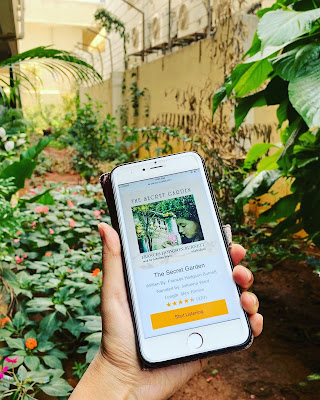
The Secret Garden by Frances Hodgson Burnett - review of a children's classic


"Magic is in me!!" 

These magical words were put forth a century ago by Frances Hodgson Burnett before I had heard about “Universe Conspires” or “Vasudaiva Kutumbakam”.

The Secret Garden is the story of Mary Lennox, a girl with a closed mindset who changes herself in a different environment and helps cure another kid who has blocked the world to himself due to a supposed deformity. The titular garden acts as a catalyst in this journey and is not the only secret that would be uncovered.

Through this novel, Burnett presents the power of the positive influence of human companionship. Having Martha and Dickon in her new life has tremendously favored Mary, the same Mary who was called "the contrary" not long ago in another life in a distant land. They seem to her to be living sufficiently happy lives, on their own terms, without materialistic wealth. Their concern for fellow humans, even animals, manifests in Mary in her approach towards Colin. Nature too plays a complimentary but important role in the emotional growth of the two children. The dried leaves and the flowers of the secret garden bring the promise of pleasant sight and feel with the onset of Spring. Mary is encouraged to care and nurture whereas Colin imbibes the magic of transformation to improve his own physical health.

☘️🍂🍃🌱🍁🌿☘️🍂🍃🌱🍁🌿☘️🍂🍃🌱🍁🌿☘️🍂🍃🌱🍁🌿☘️🍂🍃🌱
"You've been out. You've been out. There's that nice smell of leaves", he cried. She had been running and her hair was loose and blown and she was bright with the air and pink cheeked though he could not see it. "It's beautiful" she said, a little breathless with her speed.
☘️🍂🍃🌱🍁🌿☘️🍂🍃🌱🍁🌿☘️🍂🍃🌱🍁🌿☘️🍂🍃🌱🍁🌿☘️🍂🍃🌱

I listened to the story on Audible’s free collection for kids, which I was checking for my son but ended up reading for myself! Johanna Ward’s splendid narration transports you to England of the 1900s, where and when children were happy to spend time skip-roping and drew mighty pleasures from nature’s abundance. Burnett’s words are enchanting enough to keep you hooked.


It was surprising to find India and some of its culture being cited in the novel with its mention always invoking curiosity in the characters that resided in Yorkshire where most of the story is set. I liked how a lullaby in “Hindustani” was used to soothe an upset child to sleep. A minor critique here is that India is always mentioned in general, without a single mention of the specific place where Mary had lived, when talking about hot weather or dialects.

The book had turned out a perfect quarantine read and I would happily recommend it to my kid someday. We get to read rarely about walled gardens that open into one another, with wide lawns and winding walks with clipped borders.

The leatherbound Barnes and Noble edition (in the picture) has a beautiful cover and a few illustrations that will not challenge your imagination. It would certainly last longer on your shelf along with adding the luxury. Written text makes referencing easier but to read this book for the first time, I recommend the audio by Johanna Ward.

☘️🍂🍃🌱🍁🌿☘️🍂🍃🌱🍁🌿☘️🍂🍃🌱🍁🌿☘️🍂🍃🌱🍁🌿☘️🍂🍃🌱
And in the grass, under the trees, in the grey urns, the alcoves and here and there, everywhere were touches of splashes of gold and purple and white. And trees were showing pink and snow above his head and there were fluttering of wings and faint, sweet pipes and humming and scents and scents.
☘️🍂🍃🌱🍁🌿☘️🍂🍃🌱🍁🌿☘️🍂🍃🌱🍁🌿☘️🍂🍃🌱🍁🌿☘️🍂🍃🌱

Saturday, 22 August 2020

Lean In by Sheryl Sandberg - a mini review


“The phenomenon of capable people being plagued by self-doubt has a name — the imposter syndrome. Both men and women are susceptible to imposter syndrome, but women tend to experience it more intensely and be more limited by it”

And the author has backed these words by at least 6 different articles based on studies or research. She has also mentioned Tina Fey admitting to having had felt like a fraud, quoting from an interview of hers.


I could deeply resonate with these feelings but before reading Lean In I never knew that such a phenomenon even existed!!


Reading this book was like having a colleague friend, a successful one, guide me on how to navigate through a career, or even keep one and be successful. Sheryl Sandberg provides plenty of anecdotes from her own life and from others to qualify what she intends to impart through this book. Be it about corporate life as a jungle gym, or about the required mindset towards mentorship or something as basic as communication, the takeaways are new and valuable. I took away based on desires and current status in life. Plenty of eye-opening data and sound advice on handling maternity and sharing the job of parenting too, with the narrative always engaging and definitely not boring or mundane. So I recommend this book as a must-read for it has something to offer for all readers.

A special mention of the acknowledgment section which shows the amount of effort that went in to make this product. The fact that she reached out to so many people (more than a 100, and a few are acknowledged for just being influencers) for help on this book, and was reciprocated, only indicates her will and desire to help others in the best way possible. It’s astounding and highly admirable.


What prompted me to write about this book is that amidst all that she has written about her lessons and achievements (with high energy and enthusiasm), she comes across as a genuine person and that’s why I mention her as a “friend” at the beginning of this post.


Wednesday, 1 April 2020

Animal Farm - book review


Seldom, works of literature compel you to look up further on the subjects in which they delve. I have no qualms on spending additional time to explore the themes in this novel, about the author and the reception for this exceptional piece of fiction. Here is an attempt at reviewing Animal Farm, by George Orwell, that featured in Time's All-Time 100 Best English-language novels, won a retrospective Hugo award and recently featured in World Economic Forum book club members' seven favorite reads for quarantine.

My take on the narration:
  • A short read (150 pages in the pocket-sized edition), but a heavy one. Simple, clear, purposeful and effective. Some of the allegories are easy on the brain. For instance, who cannot relate the word "comrades" to a group of communists? Most chapters begin with a gist of the remainder of the chapter so although answers to our "what happens next" questions are known, what seems to be more interesting are answers to "how" and "why". Though the sentences or words were simple and direct, the prose is always engaging.
Quote:
"During the next three months there was much secret activity. Major's speech had given to the more intelligent animals on the farm a completely new outlook on life. They did not know when the Rebellion predicted by Major would take place, they had no reason for thinking that it would be within their own lifetime, but they saw clearly that it was their duty to prepare for it."
  • Orwell formed six rules for effective writing. While I looked out for these when reading, one that is clearly reflected is:
    • Never use a long word where a short one will do.
  • I started at a slow pace admiring the narration which was concise yet descriptive at times. In the beginning, the backdrop is set with great detail - the farm and all its elements, the countryside, the humans. It was heartening to find a full-length song 'Beasts of England' written and its tune described so I sang the first few stanzas in my mind in one of the tunes mentioned. In the context of this song, one cannot ignore the genius of the author that he composes this song - created for a purpose that is pure - technically better than the other songs/poems in the book. The story picks up the pace gradually and does not slow down for a hopeful twist at the beginning turns into disturbing, gory and eventually, doom.

My take on the theme/purpose:
  • Before reading the book, I did not know about Russian politics and the Soviet rebellion which serves as a basis for this satire but took gradual interest while reading the book. The divide in the factions (white and red) is depicted through the two central characters Snowball and Napolean.
Quote:
"It had come to be accepted that the pigs, who were manifestly cleverer than the other animals, should decide all questions of farm policy, though their decisions had to be ratified by a majority vote. This arrangement would have worked well enough if it had not been for the disputes between Snowball and Napolean. These two disagreed at every point where disagreement was possible."
  • More than mirroring one particular country, Orwell has shown the transition of a new free state (in this case, free from slavery) from a communist implementation to a totalitarian regime. Two of the seven commandments formed initially are the ideal beliefs of humans, but not always followed by us:
    • No animal shall kill any other animal
    • All animals are equal
  • What makes the climax appalling is the level of greed that caused the state of affairs and yet the climax is convincing for we now know that it is greed that causes one to do the worst. There could be a Napolean within each of us. Be on the lookout within you and around you.
  • Boxer is a character that can come across as someone who cannot exist in today's world. Surprisingly, there was a real-life model in the Soviet Union whose hard work and loyalty was made example of and therefore, could have served as an inspiration for this character. In my case, as I noticed people around me on the days that followed after completing the book (finished the second half in a couple of hours), I could see those to whom you could attribute the virtue of unconditional loyalty and I can only wish and hope that one's loyalty does not lead to his/her end.
Quote:
"He repeated a number of times, "Tactics, comrades, tactics!" skipping round and whisking his tail with a merry laugh. The animals were not certain what the word meant, but Squealer spoke so persuasively, and the three dogs who happened to be with him growled so threateningly, that they accepted his explanation without further questions"

This book drove me into contemplation for days. Hoping that the review enables you to pick up the book and read. If you have read it, let me know what you think of this review, in comments.

Saturday, 22 February 2020

English August - a mini review


A worn out book only indicates its popularity. Feeling proud that I read a book from my long-pending to-read list and the book has not disappointed me.

When I was reading this novel, I too was changing jobs so I could relate to the absurdity that the protagonist felt in his first job. His restlessness about the absurdity beautifully expressed in some of the lines like this one:
“Movement without purpose, an endless ebb and flow, from one world to another, journeys and passages, undertaken by cocoons not for rest or solace, but for ephemerals”.

Much of the narration is as graceful though a tad bit slow. It was amazing to read about the India of late 80s and to realise that not much has changed since except for the technological invasions. The exchange of letters feels nostalgic. An itsy bitsy complaint about not mentioning the Hindi songs in Hindi but as translations. Makes one think that the book was intended for the English (Anglo) readers, what with one of the quotes in the book asserting the Bengalis’ fascination for English!

I thoroughly enjoyed reading English August. Ending with another lovely paragraph end from the book:
“At night he would lie awake and hear the clack of his uncle’s typewriter and watch the dark shape of the bougainvillaea outside the window, and see in its twists and turns a million things, but never his future”.

Friday, 14 February 2020

Lepakshi - a photo blog


Built about five centuries ago, the temple and shrines in Lepakshi, a town in Andhra Pradesh, not very far from Bengaluru, are known for several architectural aspects. Presenting a few of them in pictures.


The ceilings of the interiors of the temple, the mukha mantapa and the arda mantapa, are adorned by several frescoes. The one in the antechamber is Asia's largest, measuring 23 by 13 feet. Photographed the frescoes in the outer hall.


Ubiquitously present are the carved stone pillars to satiate one's appetite for visual art.


The temple complex is vast, as can be gauged from the above pictures. There is a lot of open space too.


Outside the complex 200m away guards the monolith of Nandi, said to be Asia's largest.


Finally, a few more random pictures of stone carvings. I'm not including the picture of the hanging pillar (you read it right) here as a photo may not be able to do justice to its architectural aspect.

on a pillar
on the ceiling

on the steps

large meal-plate carved on the floor